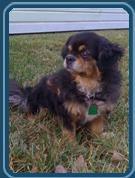
People Training 101Although my pet people are very well trained, I
can't claim all of the credit for that. Petite, a golden-colored
cocker spaniel, lived here for about eight years before I got here
and I suspect that much of the training of Honey, Babe, Boy Child,
and Girl Child was her doing.
One of the most
important things to keep in mind for people training is to be
patient. People have some shortcomings that their
training must take into consideration. For example,
their vocal construction limits their language capabilities and
neither Petite nor I have been able to teach them to speak our
language. Consequently, we used body language in the
training routine.
Another important training component is consistency. Proper
training of pets requires being extremely consistent, especially
in the beginning. After your people have learned a new trick
thoroughly, then you can experiment with some variations, but
until they've mastered it, do it the same way every time.
That helps them learn the new behavior faster and more
thoroughly.
Always let your pet people know that you appreciate their
efforts. Learning something new requires a great deal of
concentration and effort. If you reward your people for that,
then they'll be more inclined to do it again.
Above all, make the training sessions fun. People like to play,
too, and if it's an enjoyable experience for them, they'll be
easier to train.
Here are a couple of examples. (Please note that I'm not
bragging on how well my people are trained or on my training
expertise--I'm just telling it like it is.)
Honey
Every day, when Honey comes home after "Working," he gets my
dinner ready for me. Consequently, when Honey comes home, it's
time to eat. It took a while, however, for him to understand
that. I had to provide consistent reminders by vocalizing my
expectations and preventing him from starting to play with Babe
until he got my dinner for me. Honey understands my expectations
now and meets them every day. Good boy, Honey!
Babe
Babe is also very well trained, especially when it comes to
providing snacks for me. Babe will not give me snacks while
she's eating dinner, but I make my expectations known by body
language. For this trick, I put my paws on Babe's knee, rest my
head on my paws, and look at her. Babe knows that this is a
reminder for her to save a few good pieces of her dinner for me.
As soon as she's done, she'll give those to me. It took a great
deal of consistency on my part, however, to teach her this
trick. I've also worked very hard to make it entertaining for
her by doing things like sitting up when she's about to give me
those little snacks. Good girl, Babe! |